
Setting Up Virtual Machines on DaDesktop with Virt Manager
Introduction
When getting a course ready, it’s often practical to spin up a server right inside DaDesktop. You might also want to set up one or two client machines the same way—whether you stick with one operating system or mix Windows and Linux.
You can run ‘Nested VMs’ using either Virt Manager or VirtualBox. On Linux, you have the added option of using Vagrant with it, whereas if your DaDesktop machine runs Windows 10, you’ll be going with VirtualBox.
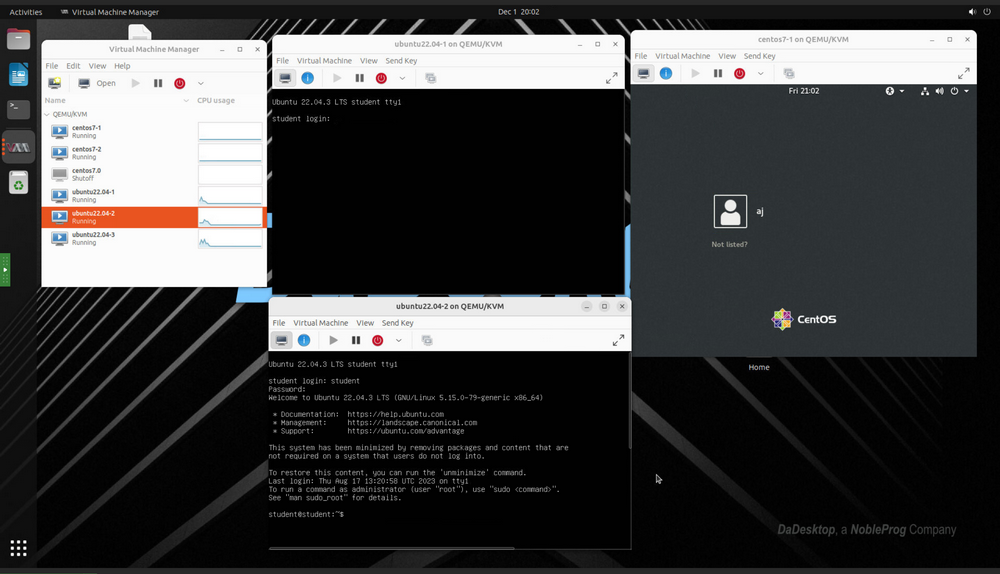
After putting things through their paces, we lean towards Virt Manager. VirtualBox has a few bugs in this setup, so for now, we don’t recommend going that route.
Virt Manager leans on the libvirt library for virtual machine management. Its desktop GUI makes creating, removing, and juggling multiple VMs straightforward. While it’s mainly built for KVM virtual machines, it also plays nice with other hypervisors like Xen and LXC.
Virt Manager pairs nicely with Vagrant as well. It’s as simple as this:
apt install vagrant-libvirt
You’ll find fewer Vagrant boxes tailor‑made for libvirt/kvm compared to VirtualBox, but you can effortlessly convert them to suit libvirt. Take a look at this guide:
https://medium.com/@gamunu/use-vagrant-with-libvirt-unsupported-boxes-12e719d71e8e
The interface gives you a quick glance at all your VMs, showing their status, CPU usage, live performance graphs for active VMs, and stats on resource utilization.
If you’re new to Virt Manager, it feels quite a bit like VirtualBox, though there are a handful of key distinctions we’ll unpack shortly.
Here’s a solid guide on working with virt-manager on Ubuntu Linux: https://www.debugpoint.com/virt-manager/
Why Choose Virt Manager Over VirtualBox?
Advantages
- Performance sees a nice boost. Virt Manager taps into VirtIO drivers for storage, networking, and graphics, which deliver markedly better speed. These virtio drivers are KVM’s paravirtualized device drivers, working with both Linux and Windows guests on KVM hosts. They cover block (storage) devices, network interface controllers, and graphics. Since they’re open source, installing them is a breeze if your Linux distro doesn’t already include them.
- A wider range of configuration options at your fingertips.
- Plays nicely with Vagrant.
- Certain parts of VirtualBox aren’t entirely open source.
- No need to recompile modules with every kernel update — one less headache than VirtualBox.
- VirtualBox has been known to break after a kernel upgrade now and then.
Disadvantages
- VirtualBox arguably has a gentler learning curve.
- Configuring host networking instead of NAT tends to be simpler in VirtualBox, though NAT handles the vast majority of networking needs smoothly on both platforms.
- VirtualBox runs on many operating systems, while Virt Manager is Linux‑only.
All told, when it comes to running servers inside a DaDesktop machine, we’d lean toward Virt Manager.
Installation
Since libvirt keeps getting better, stick with the latest non‑LTS release of Ubuntu or Debian.
To install KVM and virt‑manager, here’s a quick rundown. But for the best results, follow an up‑to‑date guide tailored to your DaDesktop operating system. One such guide is https://www.debugpoint.com/virt-manager/
sudo apt install virt-manager
sudo adduser student libvirt
sudo systemctl restart libvirtd
Restart your DaDesktop machine, then fire up Virt Manager from the Applications menu.
Configuration
-
How do I import or convert virtual machines ? While crafting a VM from scratch to match your OS and spec needs is straightforward, for more elaborate setups you’ll often want to bring in an existing virtual machine—like a specialized server or appliance. These frequently come as VMDK images, which can be fed directly into Virt Manager, though it’s not immediately obvious if the current version supports that. VirtualBox server images can’t be directly imported, but they’re simple to export into formats like Open Virtualization Format (.OVF), which Virt Manager handles without fuss. Alternatively, you could use VMware Converter if you have it, or turn to virt‑v2v (https://www.redhat.com/en/blog/importing-vms-kvm-virt-v2v). Qemu-convert is another excellent open source utility for converting between virtual machine formats.
To Convert from VirtualBox to Virt Manager KVM format check out this walkthrough: https://ostechnix.com/how-to-migrate-virtualbox-vms-into-kvm-vms-in-linux/ -
Best way to import large files inside standalone. We’ve recently rolled out a method to easily upload files from your own machine straight into your DaDesktop instance.
Alternatively, you could lean on a cloud storage service like Google Drive or Microsoft 365. Just log into the service from inside the DaDesktop machine and access your files there.
- When importing other virtual machines especially from other formats, often you will need to change graphics and / or disk types. One of the standout features of Virt Manager is its excellent VirtIO driver support. These open source, fully virtualized drivers leave generic disk, network, or graphics drivers in the dust performance‑wise, and they’re available for almost every OS—including solid support for Windows 10 guests. If your guest OS can use them, they’re generally your best bet for both compatibility and speed with Virt Manager (KVM). More info: https://wiki.archlinux.org/title/Libvirt
-
Optimal settings for virtual machines using Virt Manager These days, VirtIO drivers ship with nearly every open source server OS and can be installed on Windows without much trouble. In most cases, virtio drivers are the way to go, though occasionally you might need to reach for another type. NAT networking generally covers most needs; only if you require something more complex, like bridged host networking, will you need to dig deeper—and that tends to be trickier to set up smoothly.
https://wiki.manjaro.org/index.php?title=Virt-manager is an excellent starter guide.
Running Windows adds a few extra steps, including slipstreaming VirtIO drivers to get the Windows 10 ISO to boot.
As for disk format, raw files offer the best speed unless snapshots are a must—then go with qcow2, though it’s slightly slower. - While Wayland handles most display manager duties just fine, we still recommend sticking with X11 for the time being. That said, it might be worth giving Wayland a spin in your own environment—distros are steadily improving their support.
- Skip ksm—it does work in nested setups and within Virt Manager, but you won’t notice any real‑world benefit.
- Tech Support is on hand if you need help converting disk images for Virt Manager, or getting things set up for your DaDesktop courses.
-
Wondering where VM disk images live in the filesystem? By default, Virt Manager stashes them here, though you can point it to a different spot if you like.
/var/lib/libvirt/images